How to Play
Each game of Hexal tells the story of a battle between two witches, drawing on the power of the elements to cast powerful spells and summon creatures to protect themselves.
Deck Construction
A witch's deck represents the total amount of magical power available to them. Every card represents a fraction of their power, linking them to a kind of magic, a place, or an ally who may help them.- Creatures – people and monsters that a witch summons to fight on their behalf.
- Spells – magical effects which they can cast to change the course of a battle.
- Items – artifacts and equipment that witches create for themselves or their creatures.
- Allies – magicians, spirits, and gods that can be contacted for aid.
- Exactly 30 cards.
- No more than 2 copies of any card.
- No more than one copy of any "Limited" card. (Allies are all implicitly "Limited").
The Field
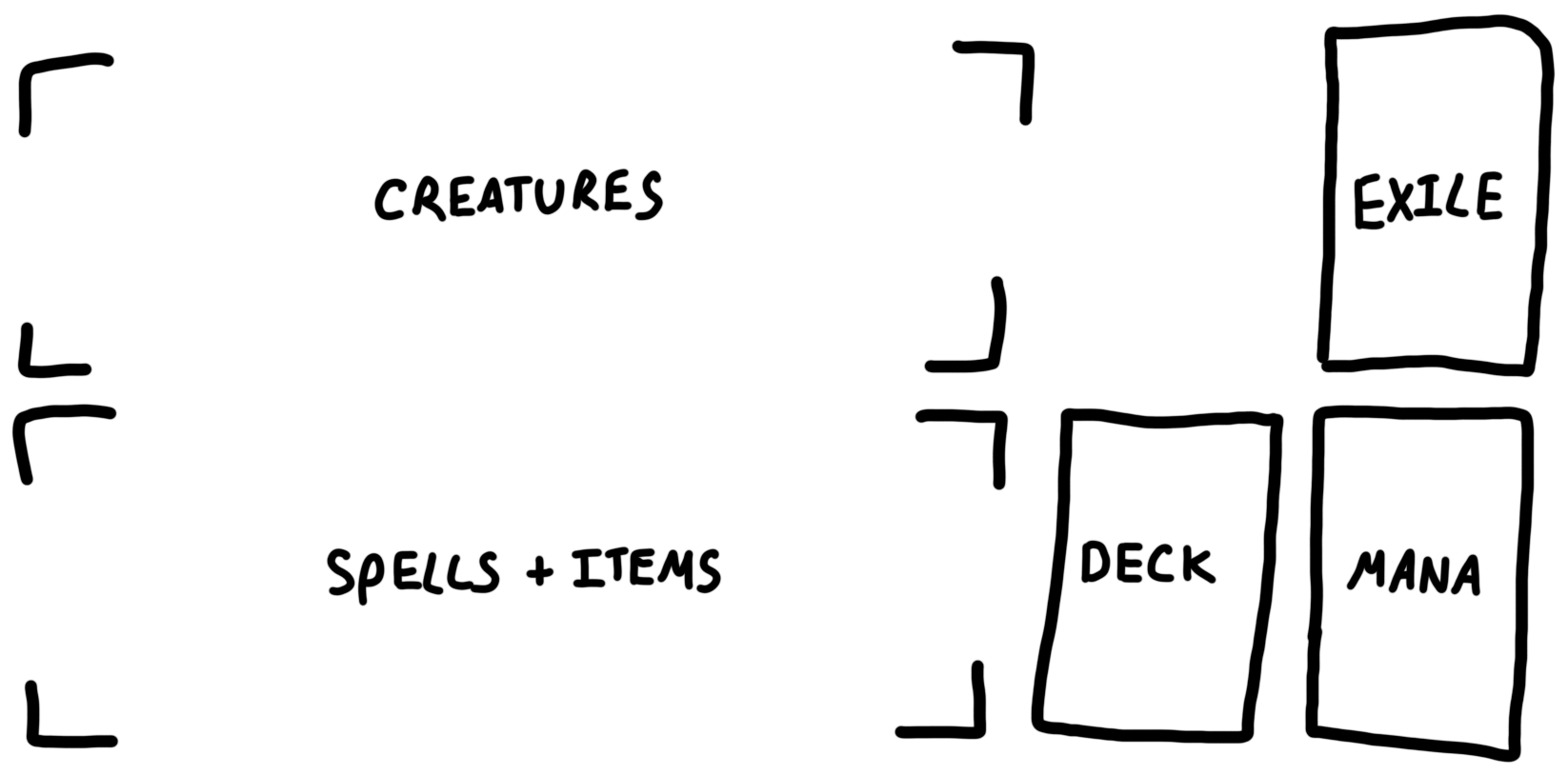
- Deck – contains your untapped potential. At the start of your turn, draw a card from here. If you run out of cards, you lose.
- Mana – contains your reserve of magic. After cards you play leave the field, they linger in your mana pool to provide elemental magical power. Cards in your Mana can be used to fuel more expensive spells.
- Exile – contains your expended energy. Cards used up from your Mana go here.
- Creatures – creatures you control. You can control any number of creatures.
- Spells / Items – spells and items under your control. You can control any number of either.
- Ally – if you control an Ally card, it lives in the Ally area.
- Limbo – when you play a card from your hand, it enters the Limbo area. Once its mana cost has been paid, it is cast/summoned and enters the field.
Card Anatomy
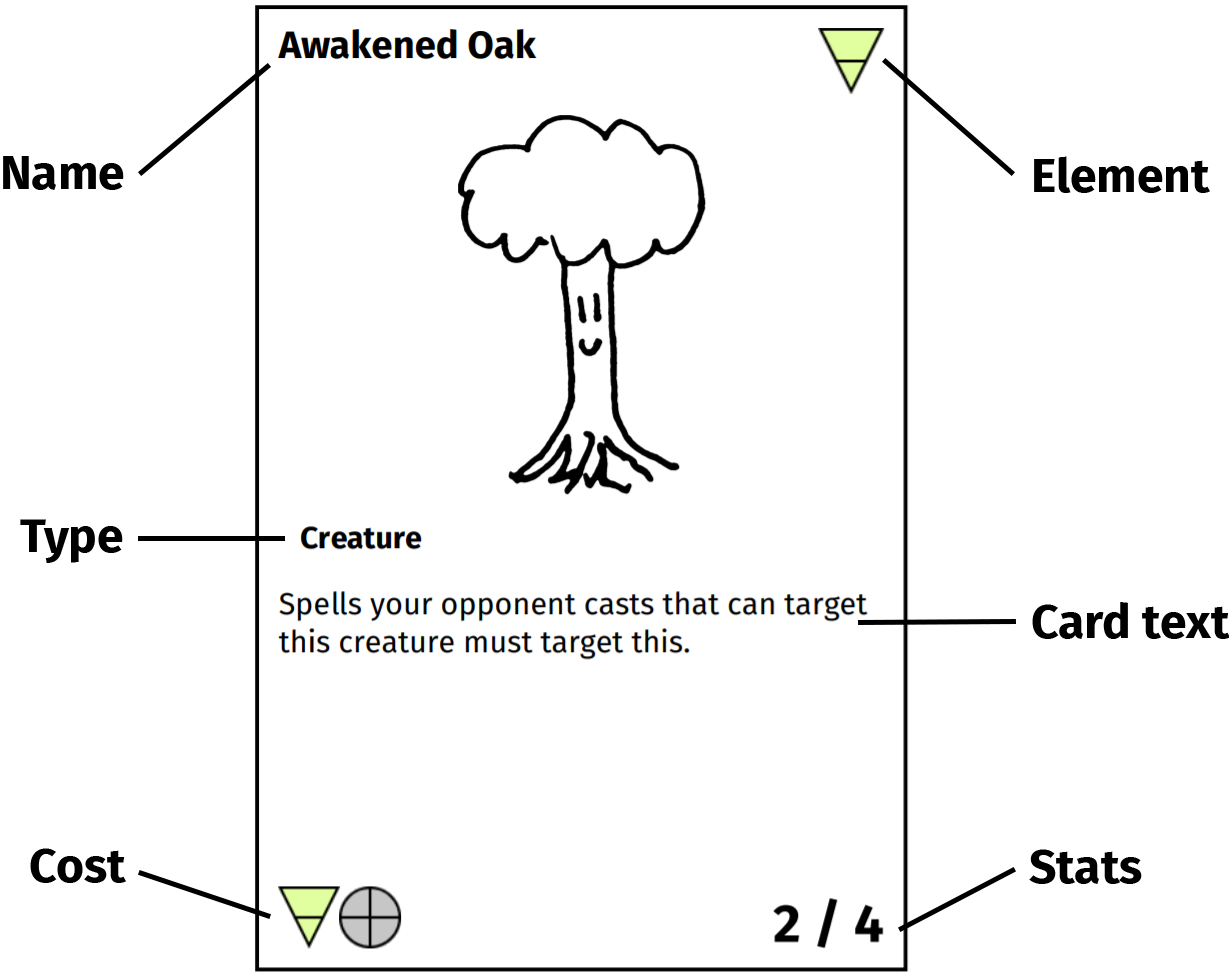
- Name – a card's name.
- Type – one of Creature, Spell, Item, or Hero.
- Subtype – cards may have subtypes (e.g. spells may be "Permanent")
- Cost – the amount of mana that you must channel when you play it. The five element symbols (Fire, Earth, Air, Water, and Spirit) represent one mana each of their element, the Neutral symbol represents one mana of any element, and the Wild symbol can only be paid with Wild mana.
- Element – a card provides one mana of its element when channeled. A card with a Channel text effect may instead provide other amounts or elements of mana, and may be channeled from other specified zones. Neutral mana pays only a Neutral cost, while Wild mana pays a cost of any symbol.
- Text – a card's text describes any effect it may have.
- Attack / Health – creatures have stats that represent their fighting ability. They are written as [Attack] / [Health]. Attack is the amount of damage a creature will deal to its target or attacker in combat. Health is the amount of damage a creature must take in a turn to be destroyed.
Gameplay
Start of Game
- Choose a player at random; they decide whether to go first or second. The player who goes first skips their first draw phase.
- Each player shuffles their respective deck, then may cut their opponent's deck.
- Each player draws four cards from their deck to form their opening hand.
- Each player chooses any number of cards from their opening hand to replace – they set those aside, draw back up to four cards, then shuffle the set aside cards back into their deck.
Turn Structure
Play alternates between players (the "active" player). Each turn is composed of phases that cannot be skipped or re-ordered.- Start of Turn – card effects which say "start of turn" occur. At the end of your Start of Turn, all cards you control recover from their exhaustion.
- Draw – you draw a card from your deck.
- Main – play cards from your hand. Only "Reaction" speed cards and effects can be activated outside of your Main phases.
- Battle – creatures under your control can exhaust to attack. See Battling below.
- Counterattack – if you made any attacks during your Battle phase, your opponent has an opportunity to counterattack (if you didn't, this phase is skipped). All creatures they control recover, then they may make as many attacks as they wish. Creatures cannot attack players directly during the Counterattack phase.
- Main II – this phase is the same as the Main phase.
- End of Turn – "end of turn" effects occur. At the end of your End of Turn phase, if you hold more than seven cards, discard one card. Repeat until you have seven or fewer cards in hand. Finally, all damage on living creatures is removed.
Battling
When a creature attacks, choose a target – either a creature your opponent controls, or your opponent themself if they control no creatures to protect them. Each battling creature takes damage equal to the Attack of the other creature; an attacked player takes damage equal to the attacker's Attack. After a creature takes damage or its Health changes, check if the total damage it's taken equals or exceeds its Health; if it does, the creature is destroyed.Triggered Effects
- Some cards contain triggered effects (e.g. "At the start of your turn, draw a card"). Effects which say "may" can be skipped, but others must be activated if their trigger occurs. Each effect can only activate once in response to a single trigger.
- Sometimes more than one effect might trigger at the same time – in that case, the player who controls the cards with those effects chooses which will go first.
- If effects controlled by both players would trigger together, the active player's effects go first. When no more effects remain for the active player, the inactive player's effects trigger.
Playing Cards
When you play a card, reveal it from your hand and place it into Limbo. You can only play normal cards during the Main phases on your turn. "Reaction" speed cards can be played at any time, as long as their triggering event (if any) has occurred. When in Limbo, you must pay a card's mana cost by channelling (exiling) cards from your Mana. For example, if you play a card with a cost of [Fire][Fire][Neutral], you could exile two Fire element cards and one Water element card from your Mana to pay its cost. These cards are exiled one at a time, and you can't channel a card if the Mana it produces doesn't contribute to the card you're playing. If you can't (or choose not to) pay a card's entire mana cost when you play it, it is exiled. Cards with no cost require no Mana; you can't choose not to pay their cost. When a card's cost is paid, it is summoned (if it's a Creature), fabricated (if it's an Item), called (if it's a Hero), or cast (if it's a Spell). These terms are all equivalent. Some card effects may say "put into play"; this is a generic term for summon, fabricate, call, or cast. If a card effect allows you to "put into play" a card, you don't need to pay that card's mana cost and it never enters Limbo.A card effect may instead name the field as the place a card is to be put, as in "put an Air creature from your hand into the field". The card is put into play on whatever the field is for it — summoned, fabricated, called, or cast — and you do not pay its mana cost for that. This is a favour rather than a play: the card enters the field and any "when this enters the field" ability sees it, but "when a card is played" does not, because nobody played anything.
When the effect instead says the card is to be played, the player chooses it and pays its printed cost out of their own Mana before it enters, exactly as they would have playing it themselves. This is a real play, so "when a card is played" sees it. A play is one card at a time, and only out of a hand or an exile — nothing is played out of your Mana, and nothing is played out of a deck. If they cannot pay, they play nothing at all: the card does not enter, their Mana is left untouched, and the effect simply achieves nothing.
Decks are the one place a card effect may not reach into. A card is taken out of a deck only by being searched for: you look at the deck, name a card, and say so out loud, and while that is happening your opponent may answer it. A card that is moved from one zone to another, or put into the field, is taken from a hand, an exile, or your Mana — places you can see, and places where how a card got there is not a surprise. A card can be put back under a deck, at the bottom of it; it just cannot be dug out of one. A card found by a search arrives in its owner's hand, which is why a search of your opponent's deck leaves the card in their hand, and not in yours.
A search can be followed straight into play. "Search your deck for an Air creature; put that card into the field" names the card the search found rather than reaching back into a deck, so the whole thing is one card effect with one answer to give: you name the card out loud during the search, and that named card is the one that goes onto the field. There is nothing to choose at that point — no count to fill in, no filter to narrow, and no player to name, because all three were settled by the search itself. The card enters the field as a favour, free, and "when a card is played" does not see it; where the card effect says the found card is to be played instead, whoever the search was for is the one who is asked to pay for it, out of their own Mana, since it is their card and it is their hand it came out of.
Summon Creature
When a creature is summoned, place it on the field. If it has an "enter field" effect, that effect occurs. Creatures are all permanent, meaning that they stay on the field after being summoned.Fabricate Item
When an item is fabricated, place it on the field. If it's permanent, it stays on the field. Otherwise, it is destroyed once its effect has occurred. If it's equipped, it must be equipped to a creature when it enters the field – otherwise, exile it.Cast Spell
When a spell is cast, place it on the field. If it's permanent, it stays on the field. Otherwise, it is destroyed once its effect has occurred. If it's equipped, it must be equipped to a creature when it enters the field – otherwise, exile it.Call Ally
When an Ally is called, place it in the Ally area of the field. It stays on the field and cannot be removed by any means. If you call another Ally while already controlling one, place the new Ally on top of the first. The effect of any Ally covered in this way no longer applies.Winning and Losing
When a player is dealt damage, they exile cards from the top of their deck equal to the damage taken. If a player must ever take a card from their deck (due to damage, a card effect, or the Draw phase) but cannot because it is empty, they lose the game. Either player may concede the game at any time by placing their hand of cards down and saying "I concede". If both players lose the game at the same time (e.g. due to an effect that says "both players draw a card"), the game is a draw. The game also ends in a draw if both players agree to end it as such, or if something outside the battle forces the game to stop.Glossary of Card Keywords
- Draw: Add the top card of your deck to your hand.
- Burn: Add the top card of your deck to your mana pool.
- Exile: Remove a card from wherever it is and place it into its owner's Exile. If it has anything equipped, those cards are Exiled too.
- Destroy: Remove a card from play and put it into its owner's Mana. If it has anything equipped, those cards are destroyed too.
- Discard: Exile a card from your hand.
- Heal: Choose a card from your Exile and place it on the bottom of your deck.
- Ready: Add the top card of your deck to your mana pool.
- Attach: Take a card and place it under the specified card. Attached cards are kept face-down; you may view them at any time but your opponent may not. When a card with attached cards leaves the field, all attached cards are detached (see below).
- Detach: Remove an attached card; the effect will specify what to do with it. If a card says "Detach to", any card detached from it goes to that place; cards without "Detach to" directives implicitly have "Detach to exile.
- Draws: Card with "Draws" will specify a situation where a player must choose a target. They must choose "Draws" cards (if they can) before any other valid targets. For example, if your opponent controls one creature with "Draws attacks" and another that doesn't draw attacks, your attacks must target the former (if possible). If they control more than one "Draws attacks" cards, you could attack any one of them.
- Search: Look through your deck for cards matching whatever pattern is specified, then add them to your hand. This doesn't count as drawing, unless the effect tells you that you draw them. You must reveal any cards that you search. If you look through your deck and cannot find a valid card, reveal your deck to your opponent. After you search, shuffle your deck.
- Final: Final cards cannot be responded to with "Reaction" effects. "When" effects still occur.